Observed worldwide every 11 June, the International Day of Play (IDOP) is the first ever UN day dedicated to children's right to play. The One Stop IDOP Shop brings together the day, its origins, the global coalition behind it, country campaigns, voices from every continent, and resources for parents, schools, and policymakers.
The first ever UN day dedicated to play, anywhere, for everyone.
On 25 March 2024, the United Nations General Assembly adopted resolution A/RES/78/268, proclaiming 11 June as the International Day of Play. It was the first time a UN day had been formally dedicated to play.
The day is co-organised by UNICEF, UNESCO, and the WHO Sport for Health Programme, with the participation of civil society, NGOs, governments, businesses, schools, and families.
Play is recognised under Article 31 of the UN Convention on the Rights of the Child as a right of every child. The International Day of Play exists to make that right visible, every year, in every country.
"States Parties recognize the right of the child to rest and leisure, to engage in play and recreational activities appropriate to the age of the child and to participate freely in cultural life and the arts."Article 31, UN Convention on the Rights of the Child, 1989
Each International Day of Play carries a theme, set by the UN agencies leading the Day with partners.
The first ever International Day of Play, three months after the UN General Assembly proclaimed it.
A call to governments, businesses, schools and families to make decisions that put play first for children.
A reminder that happy and healthy childhoods are built on play. Not as a luxury, not as a reward, but as a foundation.
Read: Protect play, protect childhood →According to the UN Department of Global Communications, the 2027 Day will be marked as the UN Special Day at Expo 2027 in Belgrade, which runs from 15 May to 15 August under the theme Play for Humanity: Sport and Music for All.
About Expo 2027 →Highlights from the third International Day of Play, 11 June 2026. No global wrap-up has been published yet; these are the moments reported by the organisations involved.
Co-hosted by the six countries that tabled the resolution, Bulgaria, El Salvador, Jamaica, Kenya, Luxembourg and Viet Nam, with UNICEF and UNESCO. Watch the full recording on UN Web TV.
webtv.un.orgLaunched on the Day, with data from almost 100 countries. More than 90 million children under five have no playthings at home, and 80 million aged two to four do not play with a caregiver.
data.unicef.orgNamed UNICEF’s youngest ever Goodwill Ambassador, with a focus on the right to play, announced on the Day and the opening day of the FIFA World Cup.
news.un.orgBhutan’s education ministry issued a circular asking all schools to set aside time for play, alongside a national event in Thimphu with more than 200 children.
unicef.org/bhutanNearly 20 toy companies gave to children in need for the Day, reaching 90% more children than in 2025.
toyassociation.orgA call for safe play spaces for children displaced by conflict, drawing on programmes in Gaza, Lebanon and Sudan.
savethechildren.orgA multi-year campaign by a global coalition of organisations, governments, and children.
The work was initiated by the LEGO Group and the LEGO Foundation, in partnership with a global coalition of organisations spanning child rights, education, humanitarian, sport, and play. Together, they worked with UN member states, children, and youth advisory groups over several years to make the case for a UN-designated day for play.
The resolution itself was led at the UN by a Core Group of Member States from all five UN regions:
The founding coalition members, many of which continue to run their own programmes and resources for the day each year:
"For more than 90 years we have championed children's right to play. We know that it can change lives. The adoption of an International Day of Play by the UN is a true testament to the power of play and the need to collectively champion and protect all children's right to play."Niels B. Christiansen, CEO, The LEGO Group
"Play is the superpower of children, but not all children experience the benefits of learning through play. An International Day of Play is an important recognition of a child's right to play. Let's work together to ensure every child has the space and time to play and be the superheroes they are."Sidsel Marie Kristensen, CEO, The LEGO Foundation
Free, practical play resources for families to use on the day and every day.
Simple activities for children from birth to twelve, using things you already have at home or in the classroom. Filter by age, time, where you are, and what each one builds. Free to use, print, translate, and share.
An open library of more than 300 play ideas, for any age, space and context. Filter by age, group size, the skills you want to build or the materials to hand, and start playing.
Practical materials, libraries and toolkits from organisations putting learning through play into practice, in schools, communities and humanitarian contexts.
TED’s curated home for talks and ideas about play, from researchers, educators, designers and parents around the world.
play.ted.comMaterials from a programme that has reached over 33 million children in 32 countries, built with BRAC, the International Rescue Committee and NYU Global TIES. Available in 27 languages.
sesameworkshop.orgPractical materials across teacher professional development, community engagement, edutainment, framing and measurement, plus an emergencies package. Built by the IRC, War Child, Plan International and the LEGO Foundation.
playmatters.orgA curated set of resources framing play as a vital part of children’s learning and wellbeing.
resourcecentre.savethechildren.netA showcase of organisations using play to drive change in early childhood education, child development and inclusion.
leverforchange.orgPrimary sources from the UN system and its co-organising agencies.
Background on the resolution, the rationale, and the day's place within the UN observance calendar. Available in all six UN languages.
un.orgPractical play activities, the science of play, age-appropriate ideas, and expert tips for parents and caregivers throughout June and beyond.
unicef.orgUNESCO's account of the inaugural observance in New York, the role of the Member State Core Group, and links to the Tashkent Declaration and the Global Agenda for Early Childhood Care and Education.
unesco.orgThe full text of the UN General Assembly resolution proclaiming 11 June as the International Day of Play. Adopted on 25 March 2024.
documents.un.orgThe academic centres, studies, and policy reports that build the case for play, and show where children are missing out.

The leading academic centre dedicated to research on play, in the Faculty of Education at the University of Cambridge. A primary source for the research that turns advocacy for play into evidence-based action.
A plain-English digest of a decade of research on learning through play: the five characteristics, the five skills, ten key findings, and links to where every report now lives.

A mixed-methods study of more than 600 students, parents and teachers across rural and urban Maharashtra. One of the first serious attempts to build an evidence base for play in the Indian context.
Co-chaired by Paul Lindley OBE and Baroness Anne Longfield CBE, an independent inquiry into how to restore play for children in England. Twelve recommendations include a National Play Strategy led by a Minister for Play, a statutory Play Sufficiency Duty for every local authority, and a ring-fenced £125m annual Play Fund.
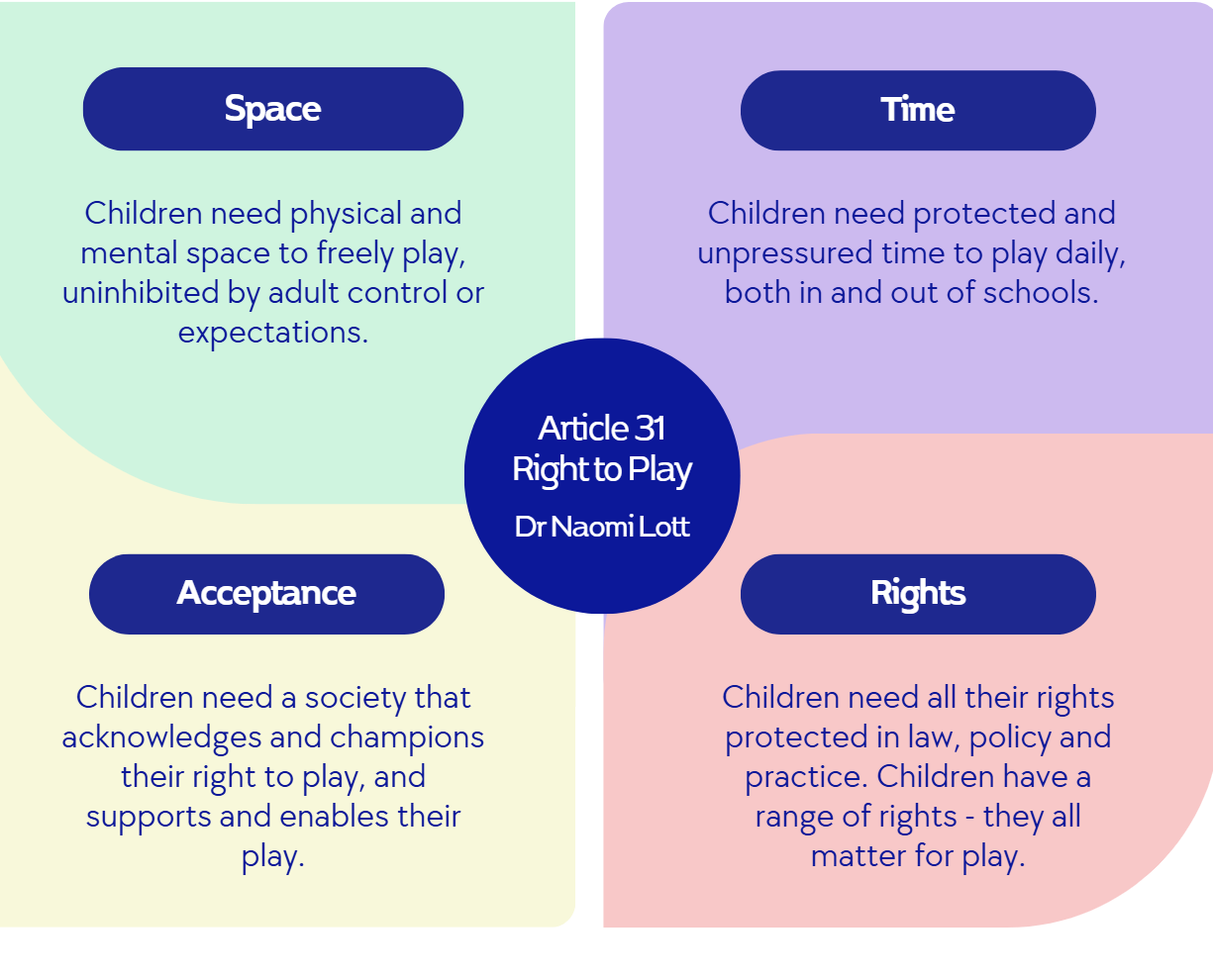
Dr Naomi Lott's framework for implementing Article 31 in practice, built around four conditions: Space, Time, Acceptance, and Rights. First published in the Human Rights Law Review, 2025.
A declaration in support of the International Day of Play, calling for action on children's right to play.

Released on 11 June 2024, the first-ever International Day of Play, the Salzburg Statement was prepared by members of Salzburg Global's Education Policymakers Network. It calls on governments, civil society, and the private sector to protect Article 31 of the UN Convention on the Rights of the Child, often described as "the forgotten article", and to give play the time, space, and support it deserves in every child's life.
Euan Wilmshurst, Co-Founder and Principal of KW Strategy, is a Salzburg Global Fellow.
The International Day of Play is also a day for reflection. A sample of leaders, governments, and global organisations on whose right to play is being honoured, and whose is not.
"Who in your community does not have the opportunity to play every day? What are the barriers? Who are the people you can work with to remove those barriers? And what action can you take together to ensure that all children can play every day?"Robyn Monro Miller, President, International Play Association
"Play is a sign that children feel safe and nurtured and loved. They feel somewhat that they can be children even in the midst of great difficulty."Catherine Russell, Executive Director, UNICEF
"Every day is a day to play. Now we have a day FOR play!"Michelle Wu, Mayor of Boston
Highlighting Jamaica's establishment of February as the national "Month of Play", Ambassador Wallace pointed to play's role as a tool for social cohesion and showcased Jamaica Moves, a national programme promoting health through active engagement across the country.H.E. Ambassador Brian Wallace, Permanent Representative of Jamaica to the UN
"I grew up in Lebanon, a country at war, where fear and disruption were part of everyday life. But even in that context, play found a way in. We weren't defined by the conflict around us. We were simply children, inventing games, building friendships, and making sense of the world in our own way. Play gave us comfort, connection, and a sense of freedom when so much else felt out of our control."Sabine Saliba, Secretary General, Eurochild
"Africa needs more support to ensure that every children's playground on the continent is also a learning field. Government policies need to recognise the centrality of play when building a policy base for foundational learning and beyond. This is how we can reverse learning poverty, grow problem-solving skills among our children, and ensure we gain tomorrow for Africa."Association for the Development of Education in Africa
"Play is the basic foundation for human development at all ages. It helps people overcome social and cultural barriers, promotes creativity and innovation, and contributes to the comprehensive mental and physical development of children. Play also promotes a culture of dialogue, solidarity, and cooperation, contributing to preventing conflicts and building peace."Ambassador Dang Hoang Giang, Permanent Representative of Vietnam to the UN (one of the six Member States that led the resolution)
"Children and young people helped build the International Day of Play network. There is nothing about them, without them. We want a world where every child's right to play is respected, protected, and fulfilled."Día Internacional del Juego, Argentina, organised by the Cámara Argentina de la Industria del Juguete
"Children are unique, strong beings with their own identity, full of rights and potential. We design environments that enable and invite exploration, play, amazement, and research. For more than 15 years, across Colombia, Mexico, and Latin America, this has been the heart of our work."aeioTU, Colombia
"I like to go to the beach to see the reef and the shells, fish, sea cucumber with the coral, not forgetting the coral reefs. Charlie loves taking me to the sea and we just swim."Agnes, aged 7, Vanuatu (shared with Save the Children)
"Play increases our intelligence, saves our lives, and builds friendships."Maheshwari, India, member of the International Day of Play Child & Youth Advisory Group
"Play is not where learning pauses, it is where it begins. It is how a child learns to fail without breaking, to see through someone else's eyes, and to find the confidence to take up space in the world."Shweta Chari, Founder, The Opentree Foundation, India
A sample of national and regional campaigns from around the world, with examples from 2026. Many more national charities, governments, and coalition partners run activities each year.
Inspired by Article 31 of the UN Convention on the Rights of the Child, the Play 31 Challenge asks schools across the UK and Ireland to extend break times, support playful outdoor learning, or create a giant "31" from loose parts to mark the day. Led by the UK Children's Play Policy Forum with Play England, Play Scotland, Play Wales, PlayBoard NI and IPA Ireland.
Euan Wilmshurst, Co-Founder and Principal of KW Strategy, is Vice Chair of the Play England board.
The LEGO Group co-led the global campaign for UN recognition of the day. Its World Play Day page gathers films, activities and ways for families and educators to mark 11 June.

Katherine Holland (Perkins) and Justin van Fleet (Theirworld) on what it will take for every child, including children with disabilities, to learn, play and thrive. "A commitment that does not reach children with disabilities is not universal. It is a promise with exceptions."
Play Scotland brings schools across Scotland into the Play 31 Challenge. More than 175 Scottish schools signed up in 2026.
playscotland.orgActivities, resources, and the Welsh-language campaign for the International Day of Play from the national charity for children's play in Wales.
play.walesPlayBoard NI, the lead organisation for play in Northern Ireland, brings schools across NI into the Play 31 Challenge to mark the day.
playboard.orgThe National Childhood Network, alongside IPA Ireland, encourages schools and settings across Ireland to mark the day with the Play 31 Challenge.
ncn.ieResources, events, and the Australian campaign for the International Day of Play, run by the national peak body for play.
playaustralia.org.auThe City of Boston and partners host a free, family-friendly celebration on 11 June, with events across early childhood centres and public spaces. 2026 was its second year.
boston.govRecreation Nova Scotia co-ordinates events across Halifax, Dartmouth, and the wider province, and offers free Community Activation Kits with planning guides and promo materials for community organisers.
recreationns.ns.caA week-long programme of workshops, drop-in activities, and a weekend carnival around 11 June (10 to 14 June in 2026), in collaboration with Singapore's Museum Roundtable and community partners. Run by the National Heritage Board.
heritage.sgUNICEF India's dedicated IDOP page with stories, advice for parents and educators, and play-based activities tailored for families across India.
unicef.org/indiaOn 11 June 2026, The Opentree Foundation convened district government and policymakers in Ahilyanagar, Maharashtra, to begin embedding play across more than 5,000 public schools. The district pledged to open the new academic year with an hour of teacher-led play in every school.
opentree.orgA conversation convened by The Opentree Foundation on access to play, policy, and the cultural barriers that hold it back, with Sarah Aiono, Tia Mathisen, Ingrid Srinath, and founder Shweta Chari. Free to watch.
youtube.comUNICEF Türkiye's dedicated page for the day, with resources for parents, educators, and policymakers, available in Turkish and English.
unicef.org/turkiyeRight To Play runs play-based programmes year-round in countries including Ghana, Mozambique, Rwanda, Tanzania, Pakistan, Thailand, and the Middle East, with International Day of Play activities across them.
righttoplay.comSave the Children, a founding coalition member, runs International Day of Play activities through its network of country offices across Africa, Asia, Latin America, and the Middle East.
savethechildren.netaeioTU's Educational Experience is built around children as protagonists of their own learning through play, art, and inquiry. The work has reached more than a million children and over 80,000 educators across Colombia, Mexico, and Latin America.
aeiotu.comHundrED's curated library of impactful and scalable play-based learning innovations, including BRAC Play Labs, Play2Learn Centres, Learn To Play, and the Play-Based Learning Observation Tool, deployed across multiple countries and contexts.
hundred.orgThe Toy Association's call to toy companies worldwide to give back, donate, and take part around the International Day of Play. In 2026 the industry reached more than 450,000 children.
toyassociation.orgAn educator-led global movement encouraging schools worldwide to dedicate one school day to free, unstructured play.
globalschoolplayday.comIf your organisation is planning something for 11 June 2027, or if play is part of your wider mission and strategy, we would love to hear about it.
Get in touch