
The right to play has been protected in the UN Convention on the Rights of the Child since 1989. Yet this right has been overlooked and misunderstood for decades. Through extensive research into the right to play, Dr Naomi Lott has developed a conceptual framework for understanding and bringing to life this children’s right.
The framework has four components, Space, Time, Acceptance, Rights, all of which are necessary to secure the child’s right to play.
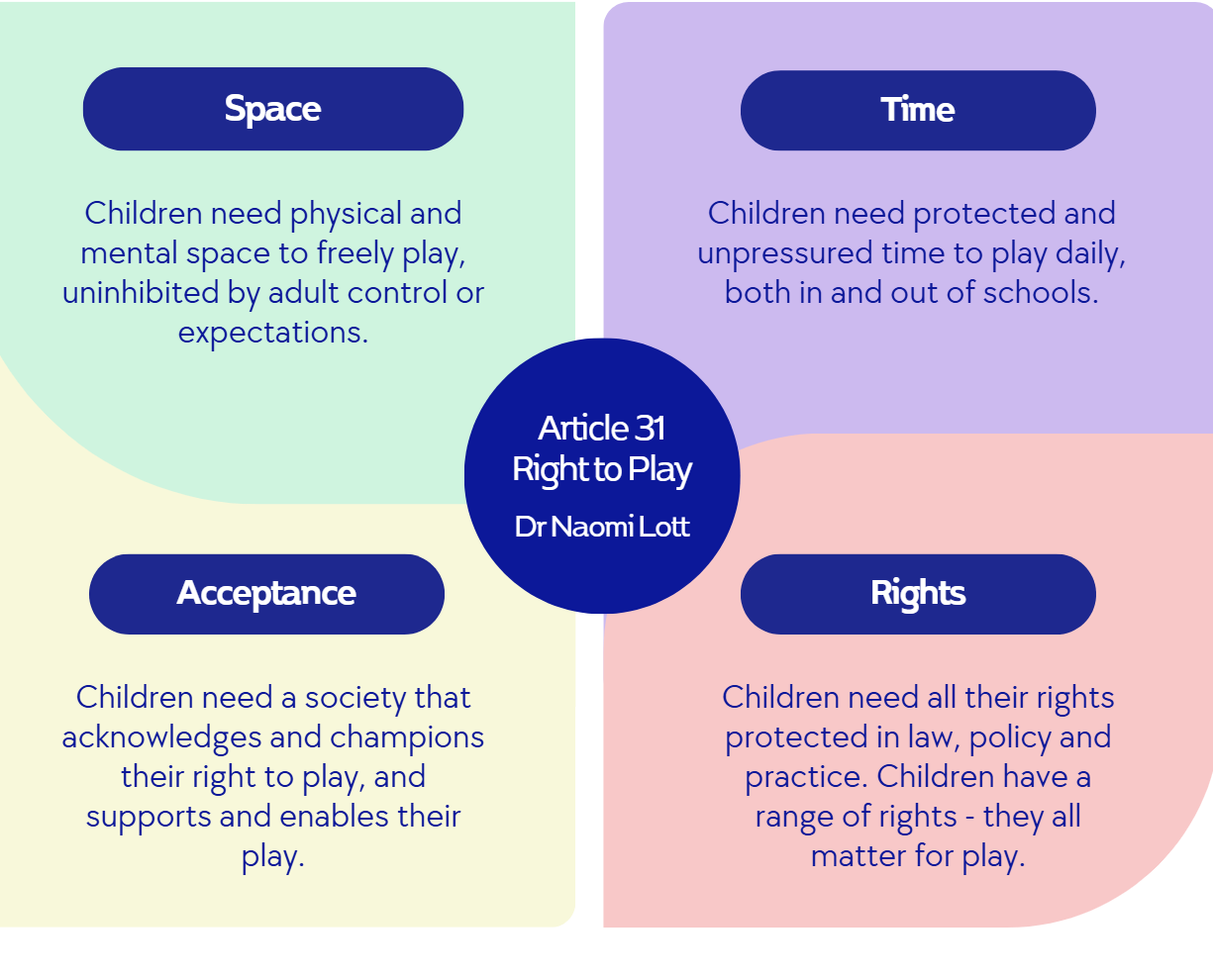
Space
The requirement that children have space to play has two elements.
First, children need access to physical space for play that offers quality play experiences. These spaces must be close to or easy to reach from home, and should include both formal and informal play spaces. They should be accessible, inclusive, and offer a range of play opportunities.
Second, children need the mental space for play. This can be supported through protection from adverse experiences and psychological barriers to play, as well as measures to help overcome these where they do exist. Play may be hampered by experiences such as abuse, trauma or poverty. Children experiencing pressure to achieve academically may be unable to switch off, or feel as though they should not waste time by playing. Older children may have internalised messages that playing is for young children only. Gendered messages about play may also prevent children playing freely.
Time
Children require time for play every day, within and outside of the school day. This includes time for play that is not adult-directed. It is important that time for play is in addition to any time for rest and engagement with the arts, which are other Article 31 rights. This factor requires limiting competing pressures on children’s free time.
Acceptance
Acceptance focuses on the existence of the right. Children have the right to play regardless of whether the adults around them want to allow them to enjoy it or not. While it is appropriate for adults to guide and support children in the enjoyment of this right, in line with Article 5 of the UNCRC, it is not the choice of the adult to permit the child to have this right. It is already theirs.
The framework places the emphasis on adults, at the individual and societal level, to:
- accept that children have this right already;
- accept play as a worthwhile activity for children;
- accept children as rightsholders, with needs that are of equal importance to those of adults; and
- champion and support children’s rights and their play.
Rights
The right to play sits within the UNCRC, which includes a range of children’s rights. All of these rights are relevant to the enjoyment of the right to play. Some do so directly, for example the right to be heard (Article 12) and the right to non-discrimination (Article 2), and others indirectly, for example the right to education (Articles 28 and 29).
To fully enjoy the right to play, children must have a system of legal and policy protections that uphold the right to play specifically, alongside other children’s rights. Ultimately, the UNCRC needs to be embedded in law and policy across all areas of government, and in the policies of all organisations that engage in any way with, or impact upon, children.
By embedding children’s rights at national, local and organisational level, children can be empowered to see themselves as rightsholders. This supports them to recognise that their needs are equal to those around them, and to advocate for their own needs, including their right to play.
Putting it to use
This framework is designed for anyone seeking to plan, deliver and evaluate positive change for play. Community groups, school leaders, local governments and international organisations can adopt it to help create strategies, policies and opportunities for ensuring that this important right is enjoyed by children everywhere.